Why did they choose someone else?
Your site read beside the firms you lose to, by five buyer types on one rubric, with the points on the page behind each verdict.
Product · Tools
Product · Intel loops · recurring, in build
Solutions · By problem
Solutions · Online stores
Resources · Learn
Resources · Guides and ideas
Resources · Company
Type your web address. Five buyer types read your site and the rivals you name, and mark the page where each one stops.
FreeNo accountBuilds in front of you



















































Each card loads its question into the console. Cards marked “in build” lean on loops under construction: listed, not sold.
Your site read beside the firms you lose to, by five buyer types on one rubric, with the points on the page behind each verdict.
The search terms rivals pay for and a modelled spend range today. Which ads they start, stop and keep running once the ad watch ships.
Your prices, delivery terms and offers beside the rivals you choose, and what a discount or delivery threshold costs in margin.
New pages, price changes and promotions on the rival sites you choose.
Whether your reviews show on the pages where buyers decide, what they say beside your rivals' reviews, and which themes buyers repeat.
The missing pieces that cost you buyers, found before you spend on a new site, with the fixes ranked by effort.
Where you and your rivals show up across reviews, paid search and organic search, read before the next spend is placed.
Five buyer types read your site and your rivals' on one rubric, and you read what assistants answer about your trade, word for word.
Every answer has the same parts: the finding, the page it came from, the first fix.
Add the competitors you lose to, if you know them. A question or a market works too.
Your site and each rival’s, read by five buyer types against one rubric. Review, search and company data join in where they apply.
Each finding marked measured or inferred, tied to the page it came from. The first fix is ranked by the effort it takes.
Three pages from the public sample report. The firm is constructed, so every page can be shown.
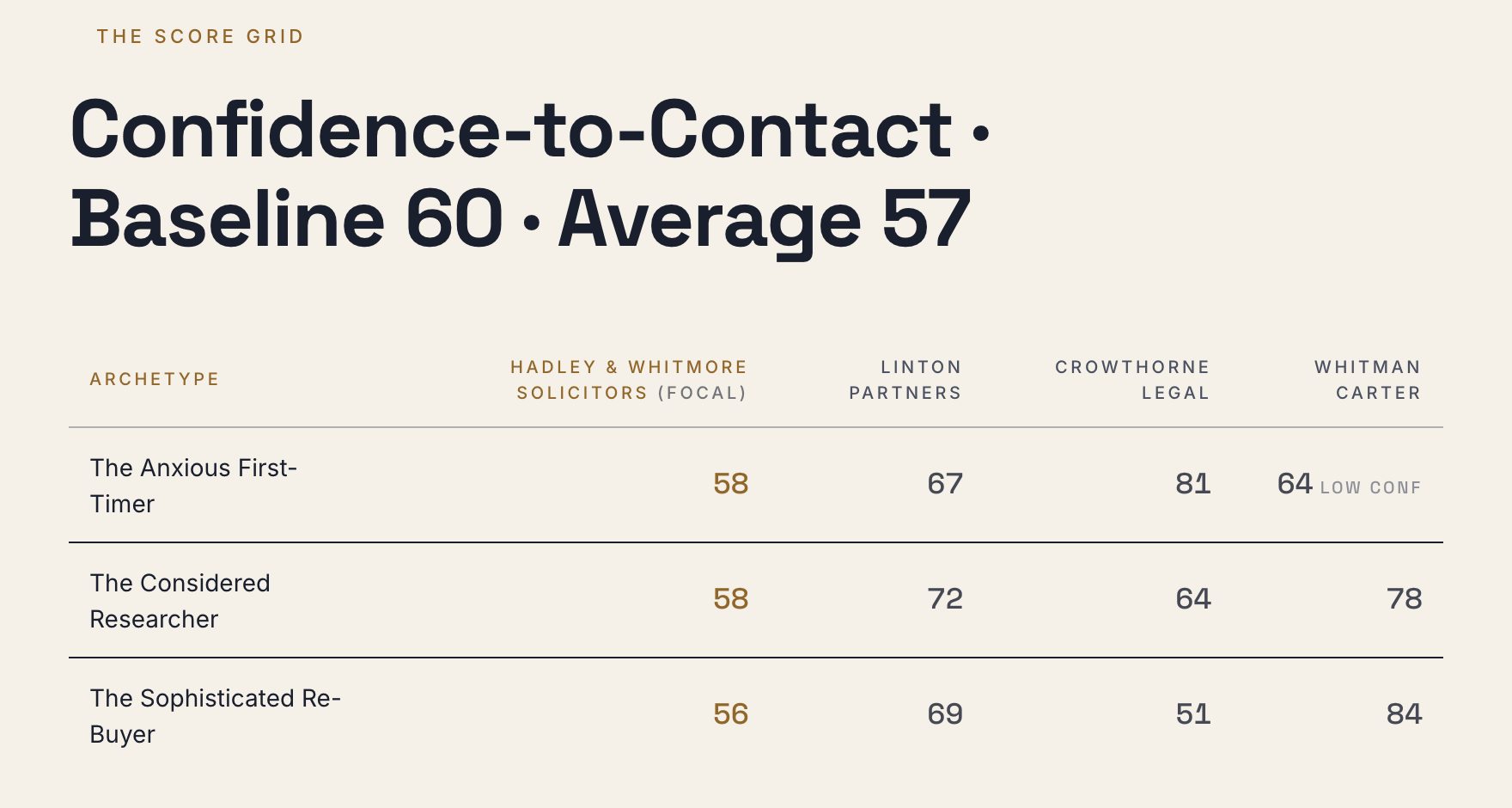
Hadley & Whitmore averages 57 on confidence to contact. Its three rivals average 70. Same buyer types, same rubric, every firm.
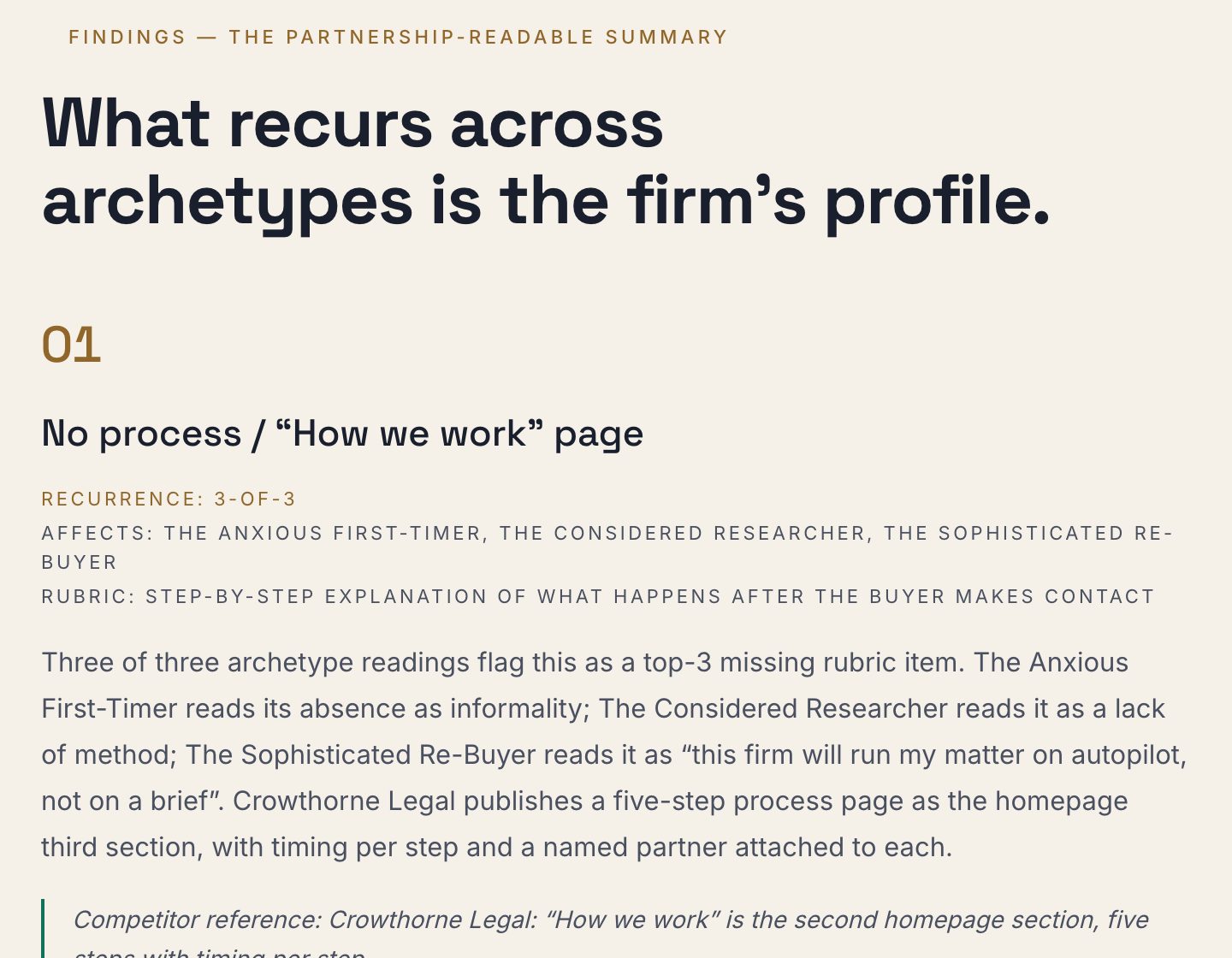
All three buyer types flagged it. Crowthorne Legal puts five steps on its homepage. Hadley & Whitmore offers a callback button.
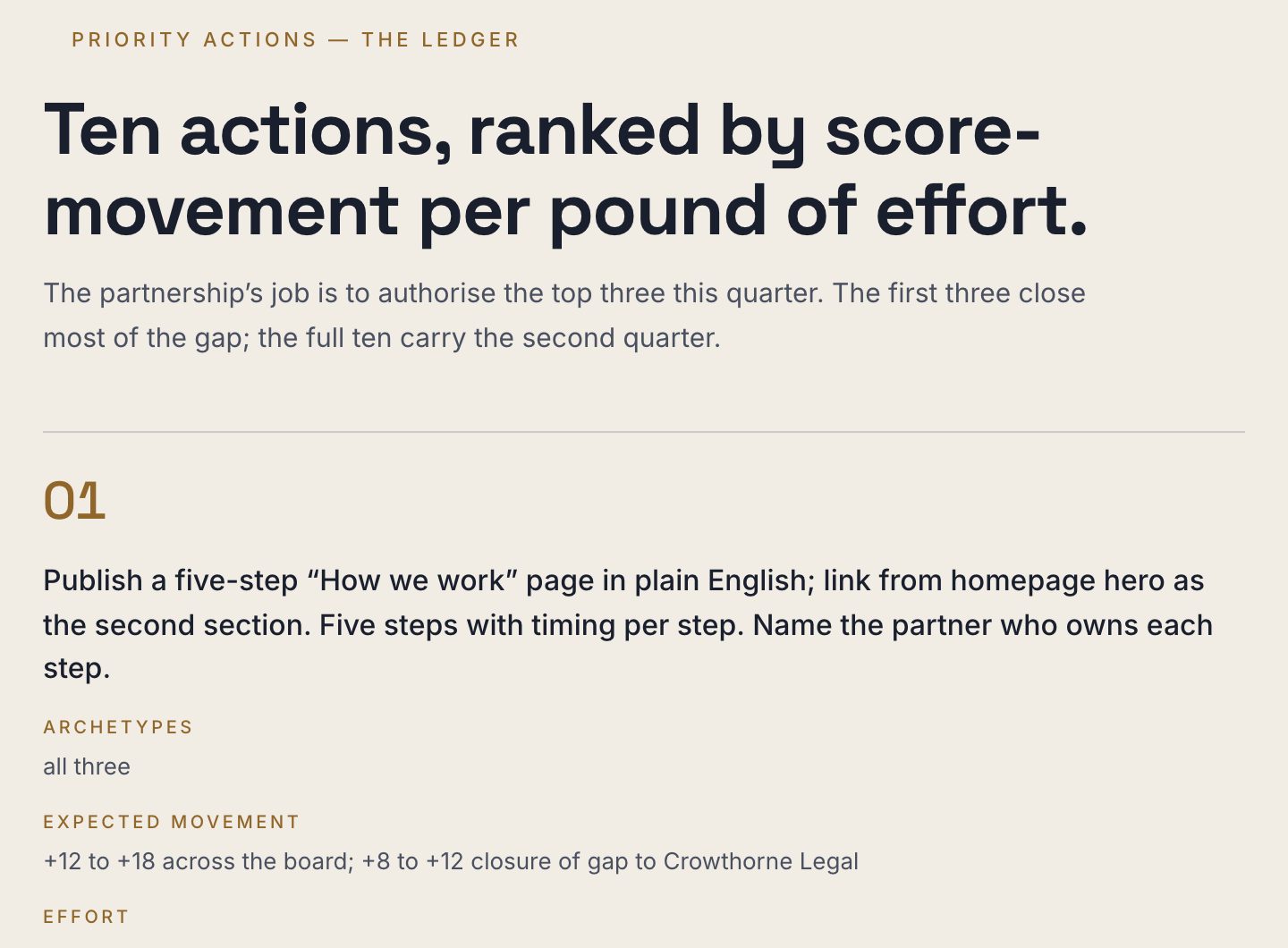
10 priority actions, each with the buyers it moves, the effort and the owner. Action 1 is a five-step process page. Effort: low.
A loop re-runs a read on the cadence you set and reports the changes. Four are in build. None runs for customers yet. None is on sale until it does.
Watches the rival sites you choose and reports what changed since the last run: new pages, prices and promotions.
Collects new reviews for you and the rivals you name, groups them into themes, and shows which themes moved.
Keeps a record of the ads your rivals run, so you can see which are new, which stopped and which have run longest.
Reads the ad accounts you connect and flags what changed in your own spend, results and creative since the last run.
Each tile states what that connection does today, from our integrations directory. A connection that does not feed a report yet is labelled that way.
Five tiers. Team checks out on this site. Command Centre is sales-led and delivered by our team. The other three are not built yet.
£29/mo
Your own memory. Sovereign, one person, one corpus, your own model key.
Live · self-serve£195/mo
We run the full read of your firm and market, then keep watch every month.
Live · sales-led£1,500/mo
Every number that matters, on one page, every week — drilling to the transaction behind it.
Not built yet£2,500/mo
Command Centre, plus your own corpus — individual and company memory, both auditable.
Not built yetfrom £4,500/mo
Agent teams producing signed action cards, with the controls a security review needs.
Six questions people ask first. The full FAQ has the rest.
Your website and the websites of the competitors you name. Five buyer archetypes score the same pages against one fixed rubric. You see where each kind of buyer stops, and which rival keeps them.
No. The free report starts with a web address. That is the whole form.
Each finding is marked measured or inferred and names the page or dataset it came from. A gap in the evidence is printed as a gap.
No. Hadley & Whitmore and its three rivals are constructed test firms, built so the whole report can be published. Its first page says so.
A loop re-runs a read on the cadence you choose and reports what changed: rival websites, reviews, rivals' ads, your own ad accounts. Four are in build. None runs for customers yet. None is on sale.
The Insight Report is free. Team is the self-serve plan at £195/mo. The pricing page lists every tier, including the sales-led one and the three not built yet.
Start with your web address. No account. No card.