Reviews and reputation watch
Will add the review view of how buyers see you and your rivals, kept current.
Product · Tools
Product · Intel loops · recurring, in build
Solutions · By problem
Solutions · Online stores
Resources · Learn
Resources · Guides and ideas
Resources · Company
Customers praise you once they have worked with you. The buyers who looked and left say nothing. The free report reads your site and your rivals' with five buyer types on one fixed rubric, and cites the points on the page behind each verdict.
Answered today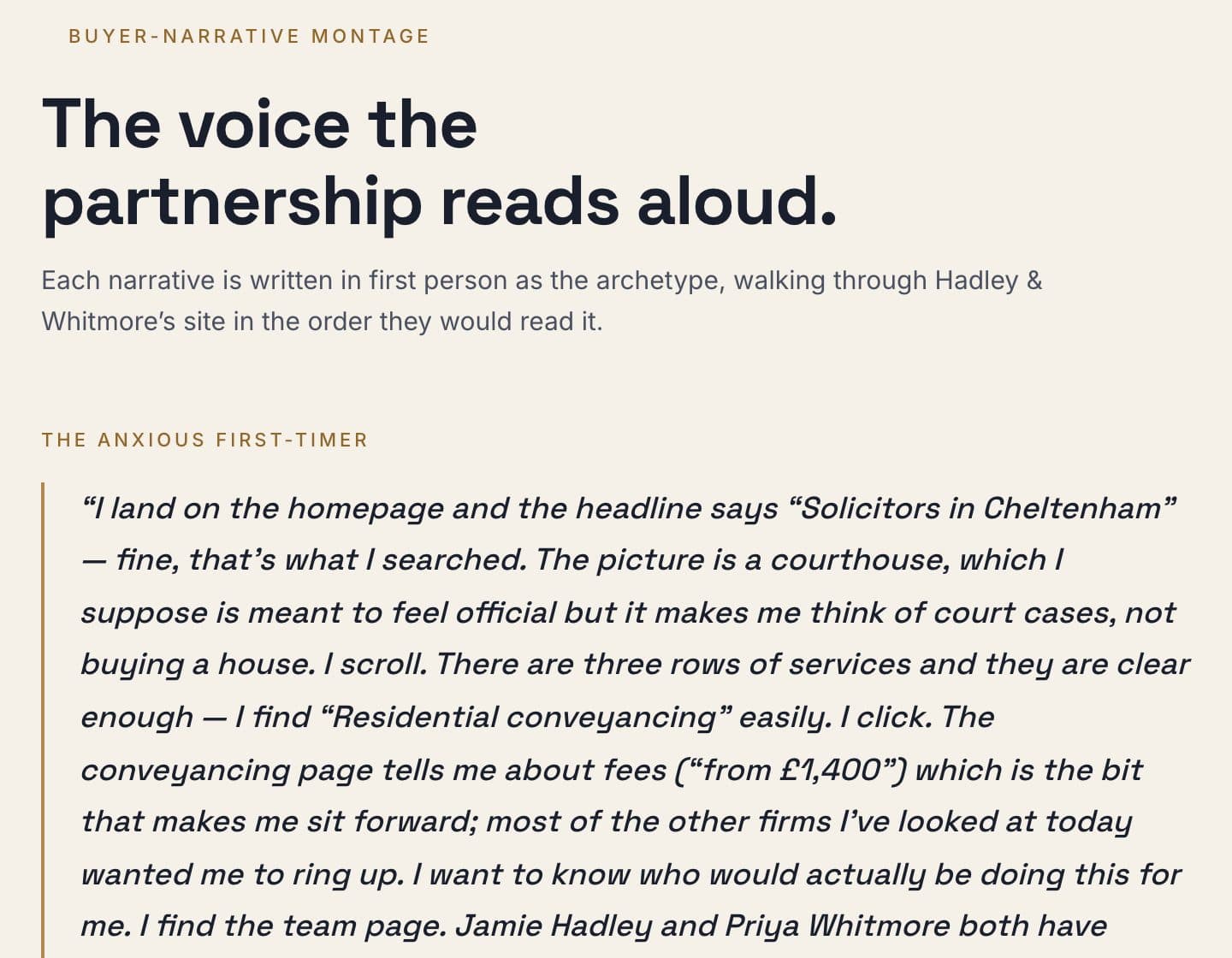
Composite phrasings of a common problem, not quotes from named customers.
Feedback from customers comes from the ones who chose you. The buyers whose view you need left without a word.
Buyers are not one person. A careful researcher reads a site differently from someone in a hurry who wants a price and a phone number. A site that suits one can lose the other.
Here is the output, from the sample report on a constructed test firm. Crowthorne Legal scores 81 with The Anxious First-Timer. Hadley & Whitmore scores 58. The recurring drag is a missing "How we work" page, and priority action one is to publish it in five steps.
Buyers also meet you on the search results page. The report shows where you sit for the terms that matter. Ask the AIs puts a question about your trade and town to several assistants and shows each answer word for word, unscored.
The limits. The buyer types are archetypes, not surveyed customers. Ask the AIs shows what assistants answer. It makes no claim about how buyers use those answers.
Every source names the module in our code that reads it. A source marked in build does not run for customers yet.
src/lib/prompt/evaluate.tssrc/lib/firecrawl.tssrc/lib/connectors/dataforseo.tssrc/components/shell/tools-meta.tsLive tools run now. Loops in build will answer it again on a cadence you choose. They are not on sale.
Your site and your named rivals read by five buyer types, side by side.
Put a question about your trade and town to several assistants and read their answers word for word.
A full reading of a constructed test firm. See the output first.
Will add the review view of how buyers see you and your rivals, kept current.
Will keep the rival side of the comparison current as their sites change.
Each industry page puts the problem in that trade's terms.
No. They are archetypes from a published library, each with the decision factors that kind of buyer weighs. They are a fixed lens, applied the same way to every site. They are not a survey of your customers.
A fixed set of questions a buyer needs answered before choosing. The same rubric is applied to your site and every rival's, so the scores compare like with like. The sample report shows it in full.
The answers several assistants give to your question, word for word. It is a reading of what they say, not a score, and we make no claim about how buyers use those answers.
Yes. Research studies are on the pricing page as an add-on, scoped on a call before anything is charged.
The free report reads your site beside theirs, five buyer types on one rubric. No account and no card to start.