Competitor website monitor
Will watch the rivals the report names and list what they change on their sites.
Product · Tools
Product · Intel loops · recurring, in build
Solutions · By problem
Solutions · Online stores
Resources · Learn
Resources · Guides and ideas
Resources · Company
Your rival publishes how it works. You publish a callback button. The buyer read both pages and picked theirs. The free report scores your site and the rivals you name with five buyer types on one fixed rubric, and cites the points on the page behind each verdict.
Answered today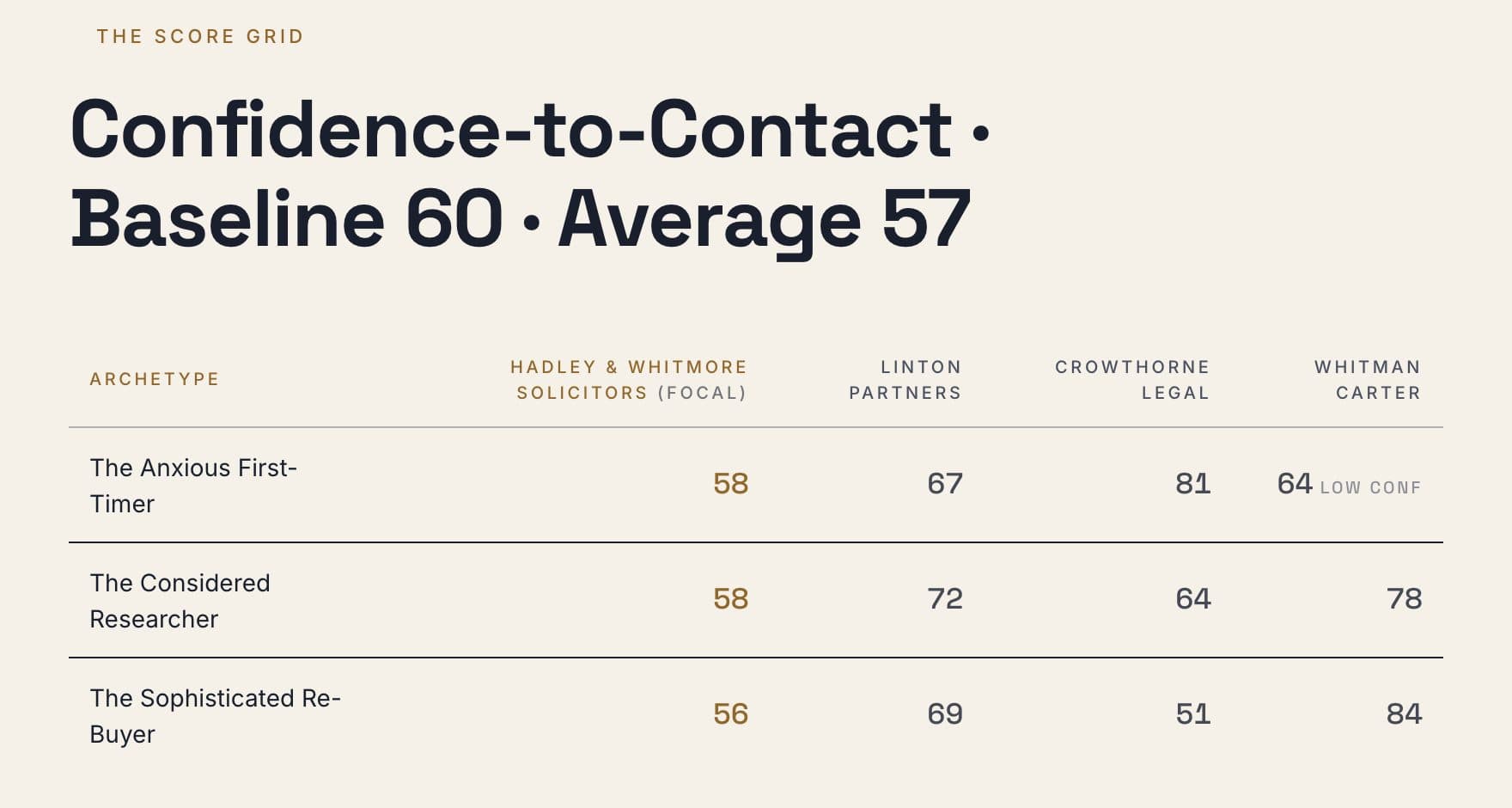
Composite phrasings of a common problem, not quotes from named customers.
Lost buyers rarely give a reason. When they do, it is polite: "we went with someone closer". On the page, that often means the other firm answered the price question and you did not.
You cannot read a rival's site as a first-time buyer. You know the trade, so you skim past the line a stranger stops on. Buyers also differ. One wants proof of past work, one wants the fee, one wants the name of the person who will handle the job.
Here is what the reading returns. In the sample report, run on a constructed test firm called Hadley & Whitmore, the firm ranks fourth of four. It averages 57; its three rivals average 70. The recurring drag is a missing "How we work" page, flagged in three of three archetype readings. Crowthorne Legal, the top scorer, puts its process on the homepage in five steps.
The limits. The report reads public pages. It does not see your enquiry log, your quotes or your analytics. It cannot tell you why one named buyer left. It shows where your pages give a buyer less than the firm they chose, which is the part of the decision you control.
Every source names the module in our code that reads it. A source marked in build does not run for customers yet.
src/lib/firecrawl.tssrc/lib/prompt/evaluate.tssrc/lib/connectors/places.tssrc/lib/connectors/competitor-properties.tsLive tools run now. Loops in build will answer it again on a cadence you choose. They are not on sale.
Name the firms you lose to. Get the side-by-side reading. No account and no card to start.
A full report on a constructed test firm. Read the output before you run your own.
Will watch the rivals the report names and list what they change on their sites.
Will keep the review side of the comparison current for you and the same rivals.
Each industry page puts the problem in that trade's terms.
No. Only that buyer can. The report shows where your pages give a first-time buyer less than the pages of the firm they chose.
It helps. Name the firms you hear about most in lost quotes. If you do not know, start with the firms that appear above you when you search for your own service and town.
No. We read their public pages the way any visitor does. Nothing is sent to them and nothing asks them to take part.
Archetypes from a published library, each with the decision factors that buyer weighs. One rubric is applied to every site in the reading, so the comparison is like for like. The sample report shows them at work.
The Insight Report is free to start: no account, no card. The pricing page lists what the paid tiers add.
The free report reads your site beside theirs, five buyer types on one rubric. No account and no card to start.