Subscriptions and trial offers
Prices from rivals' product data and the offers on their subscription pages, compared with yours on the same terms.
Product · Tools
Product · Intel loops · recurring, in build
Solutions · By problem
Solutions · Online stores
Resources · Learn
Resources · Guides and ideas
Resources · Company
Pet owners reorder the same food and switch only for a reason: the ingredients list, a late delivery, a better subscription. An Intel loop reads your store beside three rivals you name and shows which of those reasons your pages hand to a rival.
Pet owners are buying for someone who cannot tell them what they think. That makes them careful readers of ingredients, feeding guides and suitability notes for age, breed and size. A product page that answers whether this is right for their animal earns trust that a discount cannot.
Repeat purchase is the business. Shoppers compare subscription terms, the ease of changing delivery frequency and whether running out is likely. Reliable delivery is often what reviews talk about most, and a rival with a reputation for late orders is vulnerable.
Switching is also driven by reviews from other owners, especially ones that describe a fussy eater, a sensitive stomach or a dog that destroyed every other toy. Specific stories carry more weight than star ratings.
A composite, illustrative week of the kind of thing that happens in this trade. It is not a customer's diary and nothing in it is measured.
A competitor puts a trial offer on its subscription and promotes it across its site. Owners thinking of switching now have a cheaper way to try them.
Is my pricing right against rivals?A rival publishes pages for particular breeds and life stages, linked from their main menu. You want to know what they cover and whether they are worth answering.
What changed on competitor sites?A run of reviews complain that a rival's orders arrived late. That is a switching moment for their customers, if your own delivery promise is clear.
Why aren't my reviews converting?A rival's new ads show owners and animals rather than offers. You want to know whether those keep running before deciding whether to follow.
Are rivals' ads beating mine?A first-time puppy owner lands on your site from a search. You want to know whether your pages answer their questions or send them back to the results.
How do buyers see us?Public evidence about you and the rivals you name. Where a read depends on a loop that is still in build, the loop cards below say so.
Prices from rivals' product data and the offers on their subscription pages, compared with yours on the same terms.
Review text for you and each rival grouped into themes such as delivery, packaging, palatability and customer service.
New and removed pages from rivals' sitemaps, so breed guides, new ranges and discontinued lines show up as changes.
Whether each product page says which animals it suits and how to feed or use it, read the way different buyer types read it.
Paid keywords rivals bid on for food and product terms, and their ads where a public library returns them.
Your prices, delivery terms and offers beside the rivals you choose, and what a discount or delivery threshold costs in margin.
Whether your reviews show on the pages where buyers decide, what they say beside your rivals' reviews, and which themes buyers repeat.
Five buyer types read your site and your rivals' on one rubric, and you read what assistants answer about your trade, word for word.
New pages, price changes and promotions on the rival sites you choose.
A loop re-runs a read on a cadence you choose and reports what changed. None runs for customers yet, and none is on sale.
Collects new reviews for you and the rivals you name, groups them into themes, and shows which themes moved.
Watches the rival sites you choose and reports what changed since the last run: new pages, prices and promotions.
Keeps a record of the ads your rivals run, so you can see which are new, which stopped and which have run longest.
The reviews and reputation watch is being built to collect new reviews for you and your rivals and show which themes moved. It is in build and not on sale yet. Today, an Intel loop reads reviews as part of a one-off comparison.
No. The reads look at how clearly the guidance is presented, not whether it is nutritionally right. That is for your own specialists.
The stores your customers mention, the ones that appear beside you in search results, and the ones whose ads you keep seeing. An Intel loop takes three; the free Insight Report takes the competitors you name.
The free Insight Report and an Intel loop both start without a card. Paid options are listed on the pricing page.
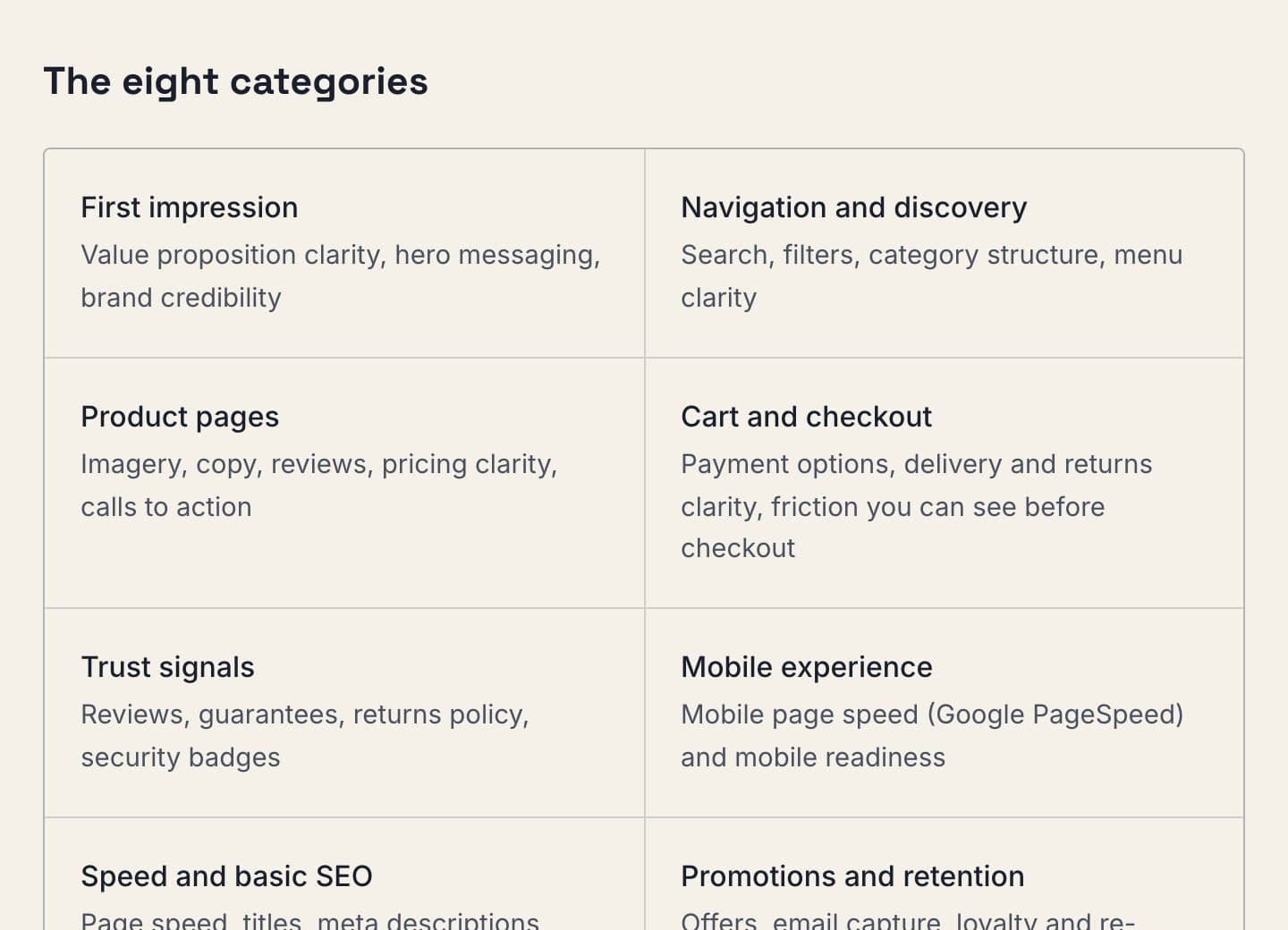
An Intel loop compares your store with three rivals you choose, across eight categories, checked by a specialist.