Seasonal ranges and gift pages
New and removed pages from rivals' sitemaps, so a seasonal range or a discontinued hamper appears as a dated change.
Product · Tools
Product · Intel loops · recurring, in build
Solutions · By problem
Solutions · Online stores
Resources · Learn
Resources · Guides and ideas
Resources · Company
A hamper buyer checks the last order date, the gift-message box and the delivery charge before the contents. Rivals launch seasonal ranges and move delivery thresholds around every gifting date. An Intel loop reads your store beside three you name and shows where the sale is decided.
Food bought online has to arrive in good condition, so delivery is part of the product. Shoppers compare delivery charges, chilled or ambient packaging, delivery-day choice and what happens if something arrives damaged. A clear delivery promise often matters more than a small price difference.
Gifting changes the shopper. Someone buying a hamper or a gift box cares about presentation, gift messages, the ability to send to a different address and the last order date before an occasion. A gift buyer who cannot find the last order date leaves for a store that prints it on the product page.
Taste is hard to judge from a screen, so shoppers lean on descriptions, provenance and reviews. Ingredients and allergen information need to be easy to find, and reviews that describe the taste and the condition on arrival do more than a row of stars.
A composite, illustrative week of the kind of thing that happens in this trade. It is not a customer's diary and nothing in it is measured.
A competitor adds a set of new gift boxes and a seasonal landing page. You want to see what they launched and how they priced it before you finalise your own.
What changed on competitor sites?A rival lowers the order value for free delivery and announces it in a banner. A shopper comparing baskets now sees a lower total there.
Is my pricing right against rivals?Several reviews of a rival complain about bottles arriving broken. Your packaging is better, but your product pages do not say how you pack.
Why aren't my reviews converting?A competitor's gift ads start appearing across social. You want to know whether they lead with price, presentation or the product before you brief your own.
Are rivals' ads beating mine?Someone buying for a relative lands on your hamper page. You want to know whether they can find the delivery date, the gift message and the allergen details without hunting.
How do buyers see us?Public evidence about you and the rivals you name. Where a read depends on a loop that is still in build, the loop cards below say so.
New and removed pages from rivals' sitemaps, so a seasonal range or a discontinued hamper appears as a dated change.
Delivery charges, thresholds and gifting options on product and checkout pages, for you and each rival.
Prices from rivals' product data and the offers on the pages you choose.
Review text grouped into themes such as taste, packaging, condition on arrival and delivery.
Rivals' ads where a public library returns them, and the paid keywords they bid on for gift and product terms.
Your prices, delivery terms and offers beside the rivals you choose, and what a discount or delivery threshold costs in margin.
New pages, price changes and promotions on the rival sites you choose.
Whether your reviews show on the pages where buyers decide, what they say beside your rivals' reviews, and which themes buyers repeat.
Five buyer types read your site and your rivals' on one rubric, and you read what assistants answer about your trade, word for word.
The search terms rivals pay for and a modelled spend range today. Which ads they start, stop and keep running once the ad watch ships.
A loop re-runs a read on a cadence you choose and reports what changed. None runs for customers yet, and none is on sale.
Watches the rival sites you choose and reports what changed since the last run: new pages, prices and promotions.
Keeps a record of the ads your rivals run, so you can see which are new, which stopped and which have run longest.
Collects new reviews for you and the rivals you name, groups them into themes, and shows which themes moved.
The delivery threshold optimiser in the free tools works through a threshold against a flat discount on your own order figures. An Intel loop then shows how your delivery terms read beside three rivals you choose.
The reads check whether allergen and ingredient information is easy to find, not whether it is correct. Accuracy stays with you.
The competitor website monitor is being built to report new pages and price changes on the rival sites you choose. It is in build and not on sale yet.
The reads look at the public sites you name. If a rival's trade site is public, it can be named; if it sits behind a login, it cannot be read.
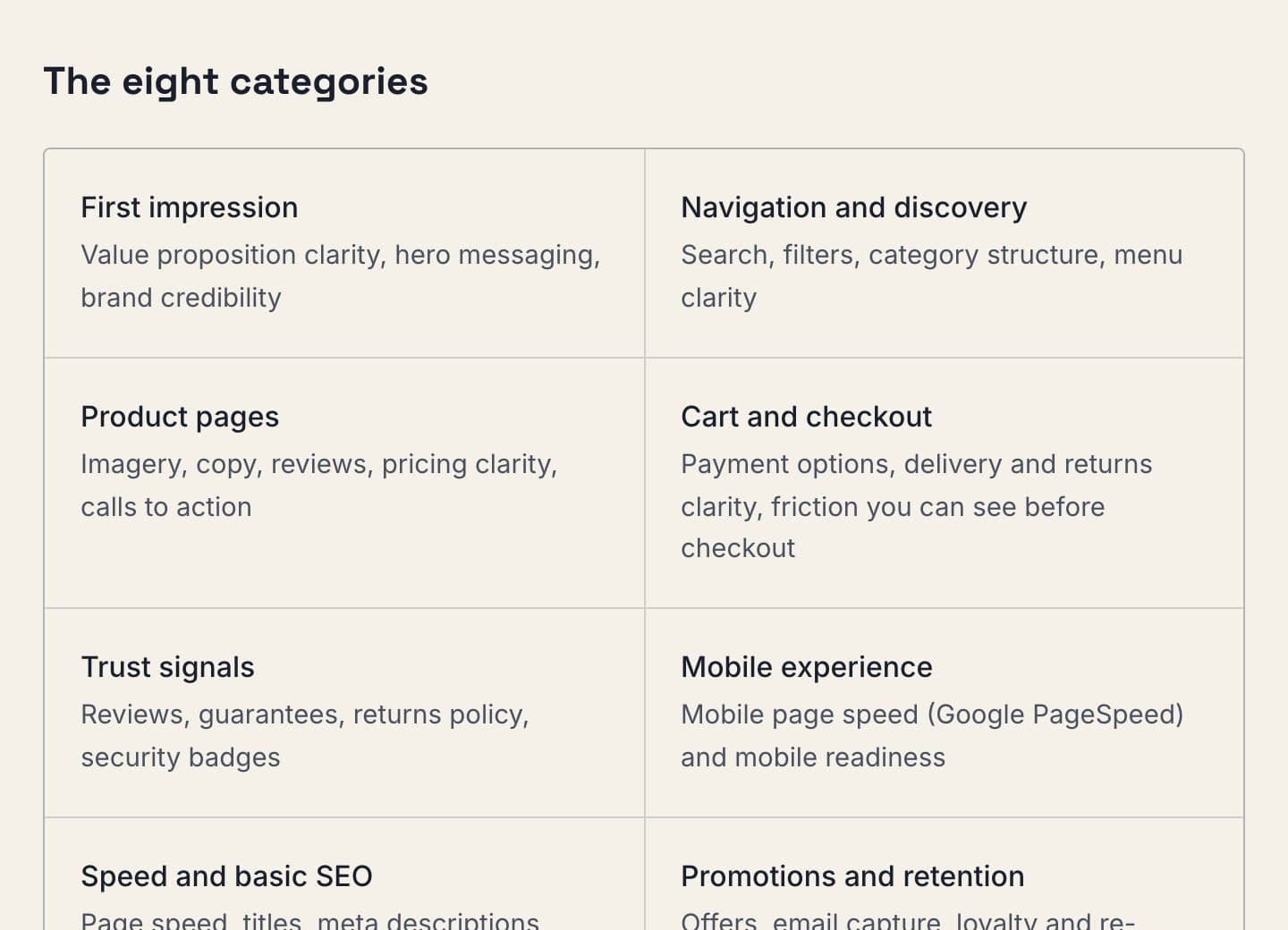
An Intel loop compares your store with three rivals you choose, across eight categories, checked by a specialist.