Subscription terms and prices
Prices from rivals' product data and the subscription wording on their product pages, compared with yours on the same terms.
Product · Tools
Product · Intel loops · recurring, in build
Solutions · By problem
Solutions · Online stores
Resources · Learn
Resources · Guides and ideas
Resources · Company
Supplement shoppers read the label panel, look for the testing page and check how to cancel the subscription before they add to basket. Rivals compete on those trust signals as much as on price. An Intel loop reads your store beside three you name and marks the page where trust is lost.
A supplement purchase starts with what is in it, how much, and why the label should be believed. Pages that show a full ingredients panel, sourcing and any independent testing give a cautious shopper something to check. Pages that rely on adjectives lose them.
Subscriptions are common, and shoppers have learned to be wary of them. They look for the terms before they sign up: what the first order costs compared with later ones, how to pause or cancel, and whether delivery is included. A rival who states this up front often wins a shopper who distrusts small print.
Reviews close the gap. Shoppers read reviews for taste, mixability, packaging and how the subscription was to manage, and they notice when a store hides its reviews or shows only a star rating with no text.
A composite, illustrative week of the kind of thing that happens in this trade. It is not a customer's diary and nothing in it is measured.
A competitor rewrites its subscription offer and moves it above the add-to-basket button. Shoppers comparing your page with theirs now see a clearer deal on theirs.
Is my pricing right against rivals?A new page about third-party testing and sourcing appears on a rival's sitemap and is linked from every product. You want to know what it says and how prominent it is.
What changed on competitor sites?Reviews of a rival start describing difficulty cancelling a subscription. Your own process is simple, but nothing on your product page says so.
Why aren't my reviews converting?A competitor's ads switch from discount-led to ingredient-led messages. You want to know which version they keep running before you change yours.
Are rivals' ads beating mine?Paid social, paid search and affiliate partners all claim credit for the same sales. Before moving money, you want to see which channels your rivals invest in and where they rank.
Which channel should we fund?Public evidence about you and the rivals you name. Where a read depends on a loop that is still in build, the loop cards below say so.
Prices from rivals' product data and the subscription wording on their product pages, compared with yours on the same terms.
New ingredient, sourcing and testing pages from rivals' sitemaps, so a trust page that goes live is visible as a change.
Review text for you and each rival grouped into themes such as taste, mixability, delivery and subscription management.
The paid keywords rivals bid on for ingredient and product terms, and where each store ranks for the terms that bring buyers.
Rivals' ads where a public ad library returns them, tracked as new, stopped and longest-running.
Your prices, delivery terms and offers beside the rivals you choose, and what a discount or delivery threshold costs in margin.
Whether your reviews show on the pages where buyers decide, what they say beside your rivals' reviews, and which themes buyers repeat.
Where you and your rivals show up across reviews, paid search and organic search, read before the next spend is placed.
The search terms rivals pay for and a modelled spend range today. Which ads they start, stop and keep running once the ad watch ships.
A loop re-runs a read on a cadence you choose and reports what changed. None runs for customers yet, and none is on sale.
Watches the rival sites you choose and reports what changed since the last run: new pages, prices and promotions.
Collects new reviews for you and the rivals you name, groups them into themes, and shows which themes moved.
Keeps a record of the ads your rivals run, so you can see which are new, which stopped and which have run longest.
Reads the ad accounts you connect and flags what changed in your own spend, results and creative since the last run.
No. The reads compare how clearly stores present their products, terms and proof. Whether a claim may be made is a matter for your regulatory adviser, and nothing here replaces that advice.
Yes, as a one-off read in an Intel loop, which compares your store with three rivals you choose across eight categories and has a specialist check every finding. A recurring watch on rivals' prices is being built as the competitor website monitor, which is not on sale yet.
The own-ads audit loop is being built to read ad accounts you connect, read-only, and report what changed in spend, results and creative. It is in build and not on sale yet.
It reads your site the way five buyer types would, beside the competitors you name, and shows where each would stall. It starts without an account or a card.
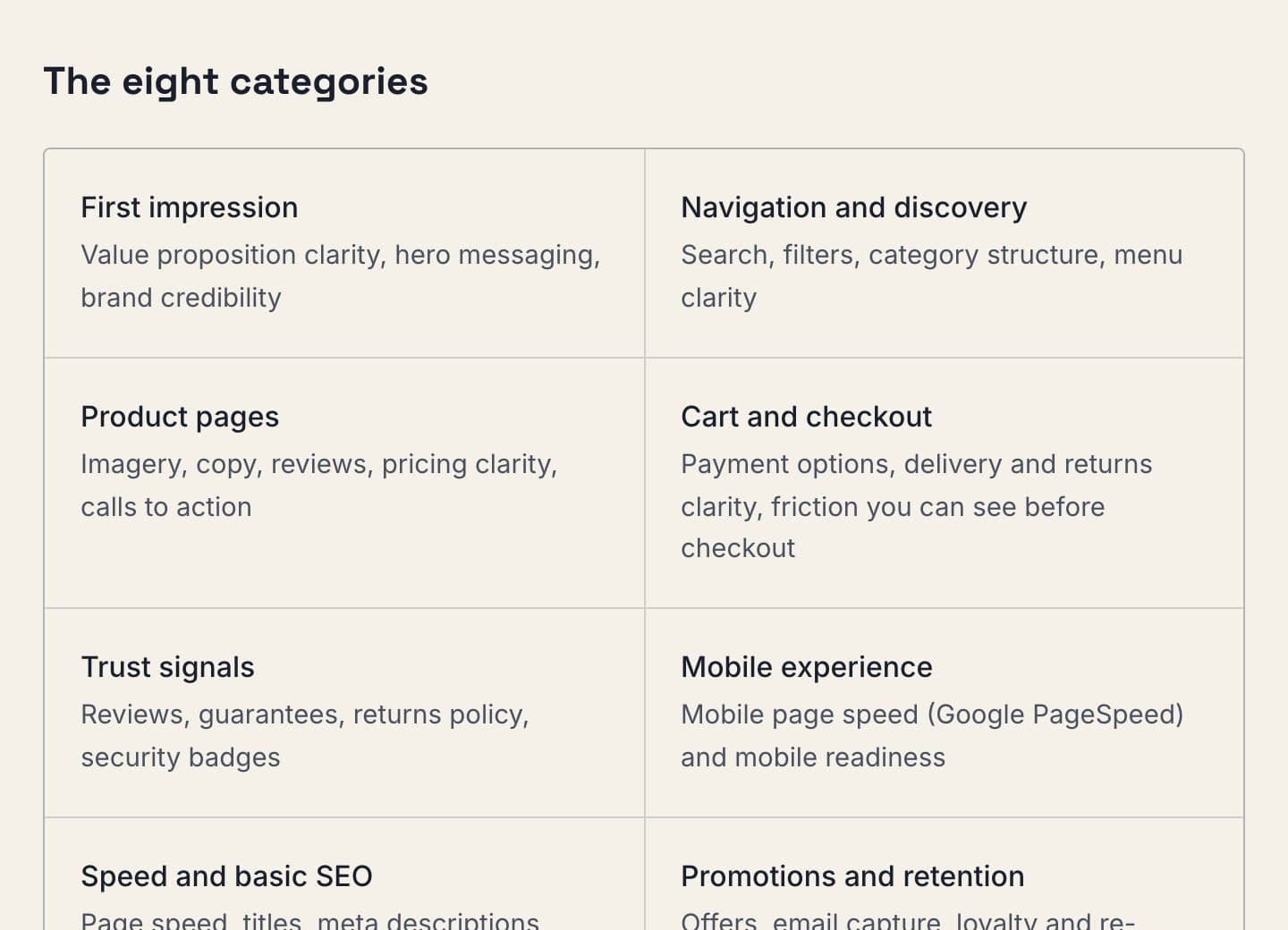
An Intel loop compares your store with three rivals you choose, across eight categories, checked by a specialist.