Delivery, assembly and returns terms
Whether delivery charges, room-of-choice service, assembly and returns for bulky items are clear on the product page, for you and each rival.
Product · Tools
Product · Intel loops · recurring, in build
Solutions · By problem
Solutions · Online stores
Resources · Learn
Resources · Guides and ideas
Resources · Company
A sofa buyer checks the dimensions against the door frame, then the delivery charge, the room-of-choice service and the returns terms for a bulky item, on several sites. An Intel loop sets your store beside three rivals you name and shows where that buyer hesitates.
A sofa or a dining table is a purchase the shopper lives with, so they read carefully. Dimensions, materials, care instructions and photographs that show scale all matter. A product page that leaves the buyer guessing about whether it will fit through the door sends them to a rival who answers it.
Delivery is part of the product. Buyers compare delivery charges, whether the item is brought to the room of choice, whether assembly is offered and how returns work for a bulky item. A rival with clearer delivery terms can win a sale against a nicer product.
At that price, payment options count. Shoppers notice whether spreading the cost is offered, whether samples of fabrics or finishes are available and whether there is a showroom or some other way to see the piece first.
A composite, illustrative week of the kind of thing that happens in this trade. It is not a customer's diary and nothing in it is measured.
A competitor changes its delivery terms on large items and adds a banner saying so. Your prices are similar, but the total at checkout now looks higher on your site.
Is my pricing right against rivals?A rival publishes a collection of new product pages in a style close to your best-seller. You want to see what they launched and how they priced it.
What changed on competitor sites?New reviews of a rival praise the delivery team and the room-of-choice service. Your own reviews say the same, but your product pages never mention it.
Why aren't my reviews converting?Plenty of visitors order fabric samples; fewer come back to buy. You need to know whether the product pages answer the questions that arise once the sample arrives.
Rebuild, or fix what we have?You spend on both paid search and social ads for the same ranges. Before the next budget round, you want to see which channels rivals invest in and where they rank.
Which channel should we fund?Public evidence about you and the rivals you name. Where a read depends on a loop that is still in build, the loop cards below say so.
Whether delivery charges, room-of-choice service, assembly and returns for bulky items are clear on the product page, for you and each rival.
New and removed product pages from rivals' sitemaps, and prices from their product data, so a new range or a price change is a dated record.
Review text grouped into themes such as delivery, build quality, comfort and customer service, for you and each rival.
Dimensions, materials, care and sample offers, read the way different buyer types read them.
The paid keywords rivals bid on for product terms, their organic ranks, and their ads where a public library returns them.
Your prices, delivery terms and offers beside the rivals you choose, and what a discount or delivery threshold costs in margin.
Whether your reviews show on the pages where buyers decide, what they say beside your rivals' reviews, and which themes buyers repeat.
The missing pieces that cost you buyers, found before you spend on a new site, with the fixes ranked by effort.
Where you and your rivals show up across reviews, paid search and organic search, read before the next spend is placed.
New pages, price changes and promotions on the rival sites you choose.
A loop re-runs a read on a cadence you choose and reports what changed. None runs for customers yet, and none is on sale.
Watches the rival sites you choose and reports what changed since the last run: new pages, prices and promotions.
Collects new reviews for you and the rivals you name, groups them into themes, and shows which themes moved.
Reads the ad accounts you connect and flags what changed in your own spend, results and creative since the last run.
Yes. An Intel loop's cart and checkout category covers delivery and returns clarity for your store and three rivals you choose, and a specialist checks every finding before you see it.
No. The reads look at public websites, reviews, search and ads. What happens in a showroom is outside what they can see.
The competitor website monitor is being built to read prices from rivals' product data on each run and report changes. It is in build and not on sale yet.
The free Insight Report reads your site the way five buyer types would and ranks the actions by effort, so you can see whether the problem is a few missing pieces or the whole structure before committing to a rebuild.
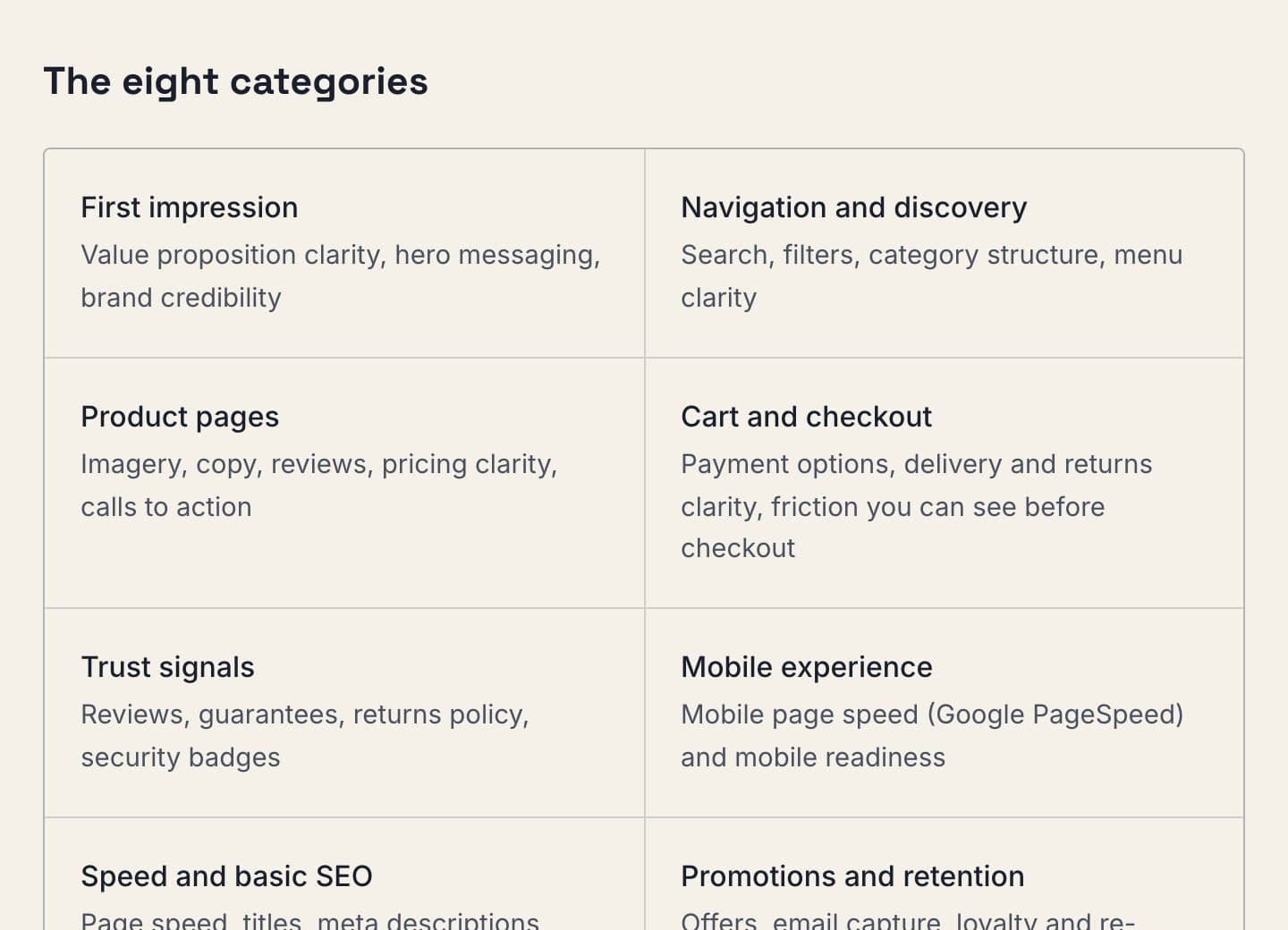
An Intel loop compares your store with three rivals you choose, across eight categories, checked by a specialist.