Practice-area pages
Which matters each rival gives its own page, and which new ones appear in their sitemaps over time.
Product · Tools
Product · Intel loops · recurring, in build
Solutions · By problem
Solutions · Online stores
Resources · Learn
Resources · Guides and ideas
Resources · Company
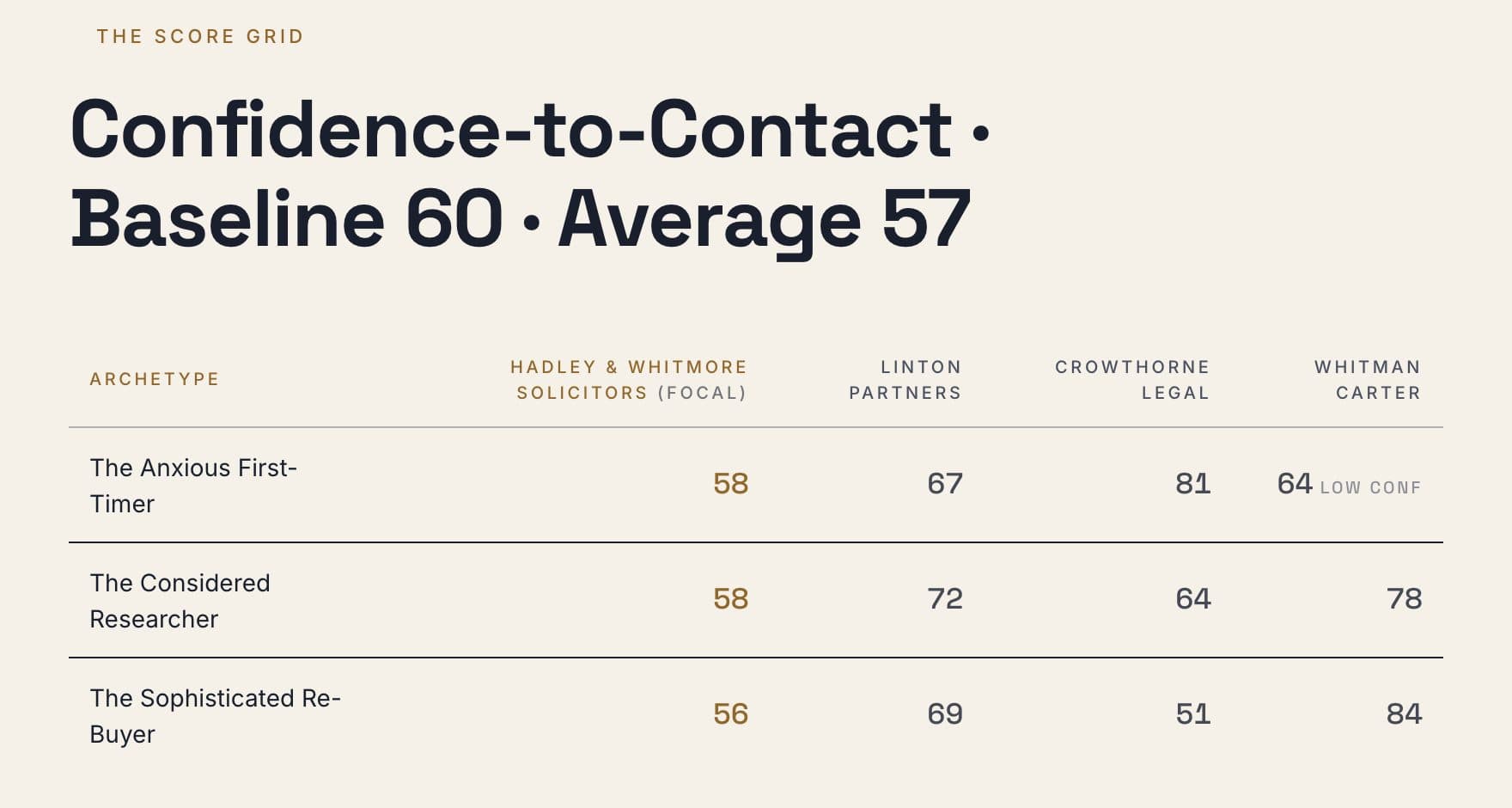
A prospective client reads several firms' websites before ringing one. They look for the fee, the name of the person who will handle the matter, and the reviews. In the sample report, run on a constructed test firm, Hadley & Whitmore ranks fourth of four: it has no “How we work” page, and Crowthorne Legal puts its process on the homepage in five steps. The free audit reads your site the same way.
People instruct a solicitor rarely, and often at a stressful moment: a house move, a divorce, a dispute, a will after a death in the family. They have no way to judge the quality of legal advice in advance, so they judge what they can see instead.
What they can see is the website. They check whether the practice area they need has its own page, written for someone in their position, or sits in a list. They look for how fees work: fixed fee, hourly, or an estimate before the meter starts. They look for a face and a name for the person who will handle the matter.
Proof comes next: reviews on Google and the review sites, accreditations the firm displays, and whether the tone of the reviews matches what the site promises. A firm that is excellent in the room can still lose the enquiry on the page.
The question a solicitor’s buyer is usually trying to settle is whether this firm will be straight with them about cost before the meter starts. The free audit checks whether your site answers it, and whether your rivals’ sites do.
A composite, illustrative week of the kind of thing that happens in this trade. It is not a customer's diary and nothing in it is measured.
A buyer requests a quote, receives it, and never replies. They had also read two rival sites that put a fixed-fee conveyancing breakdown on the page.
Why did they choose someone else?A competing firm adds a page for a specific kind of matter you handle every month. Nobody at your firm notices, because nobody reads competitors' sitemaps.
What changed on competitor sites?The site is a few years old and looks tired next to a rival's. The question on the table is a full rebuild, when the real gaps may be a handful of missing pages and an absent fee explanation.
Rebuild, or fix what we have?The complaint is about communication, not the outcome. Reading the reviews of three rivals shows the same theme running through the market, and one firm that answers it on its homepage.
Why aren't my reviews converting?A worker facing dismissal reads your employment page and a rival's on a phone. One explains what happens at a first consultation; the other only lists the firm's awards.
How do buyers see us?Public evidence about you and the rivals you name. Where a read depends on a loop that is still in build, the loop cards below say so.
Which matters each rival gives its own page, and which new ones appear in their sitemaps over time.
Whether fees, fixed-fee packages or estimates are published, and how prominently, on your pages and theirs.
Google rating, review count and the recurring complaints and praise in review text, for you and each named rival.
Where each firm sits for the searches that carry an instruction, read from the live results page.
Where a cautious first-timer, a comparer and a busy professional would each stall on your pages.
From our own keyword research, with its source and date. The free audit page for this trade sets your site against it.
Your site read beside the firms you lose to, by five buyer types on one rubric, with the points on the page behind each verdict.
Five buyer types read your site and your rivals' on one rubric, and you read what assistants answer about your trade, word for word.
Your prices, delivery terms and offers beside the rivals you choose, and what a discount or delivery threshold costs in margin.
Whether your reviews show on the pages where buyers decide, what they say beside your rivals' reviews, and which themes buyers repeat.
The missing pieces that cost you buyers, found before you spend on a new site, with the fixes ranked by effort.
A loop re-runs a read on a cadence you choose and reports what changed. None runs for customers yet, and none is on sale.
Watches the rival sites you choose and reports what changed since the last run: new pages, prices and promotions.
Collects new reviews for you and the rivals you name, groups them into themes, and shows which themes moved.
Keeps a record of the ads your rivals run, so you can see which are new, which stopped and which have run longest.
No. We read websites and public signals and report what we find. Whether a change fits your regulatory obligations is a judgement for your firm and its compliance lead.
The firms you actually lose instructions to, if you know them. If you do not, name the firms that appear when you search for your main practice area in your town.
That is the competitor website monitor. It is in build and not on sale yet. Today the free Insight Report reads your site and named rivals once, side by side.
Yes. The sample report is a full read of a constructed test firm of solicitors, published so you can judge the output before running your own.
The free report reads your site beside the competitors you name. No account and no card to start.