Versioned REST API
An OpenAPI 3.1 document, one error envelope and additive-only changes within v1.
Product · Tools
Product · Intel loops · recurring, in build
Solutions · By problem
Solutions · Online stores
Resources · Learn
Resources · Guides and ideas
Resources · Company
Market scans, report facts, review reads, validation studies and more, through a versioned REST API and a remote MCP server your assistant tools can connect to. Every key carries explicit scopes and a daily spend cap.
Offered · run by a specialist Live, sales-led. Keys are issued by us after a conversation; there is no self-serve sign-up.
The Audience Intel engine in your own tooling: a versioned REST API and a remote MCP server, with per-key scopes and daily spend caps. Keys are issued after a conversation.
Everything the site does runs on one engine, and the engine has an API. Build your own dashboard, internal workflow or assistant set-up, and call the engine directly instead of through our pages.
The REST API lives under one versioned path. It covers market-scan reports and the facts inside them, review reads, validation studies, prospecting runs, continuous assessment and more, all described in an OpenAPI 3.1 document you can download. Within version one, changes are additive only: new fields and endpoints, never renamed or removed ones, and never a new required input. Errors share one envelope with stable codes.
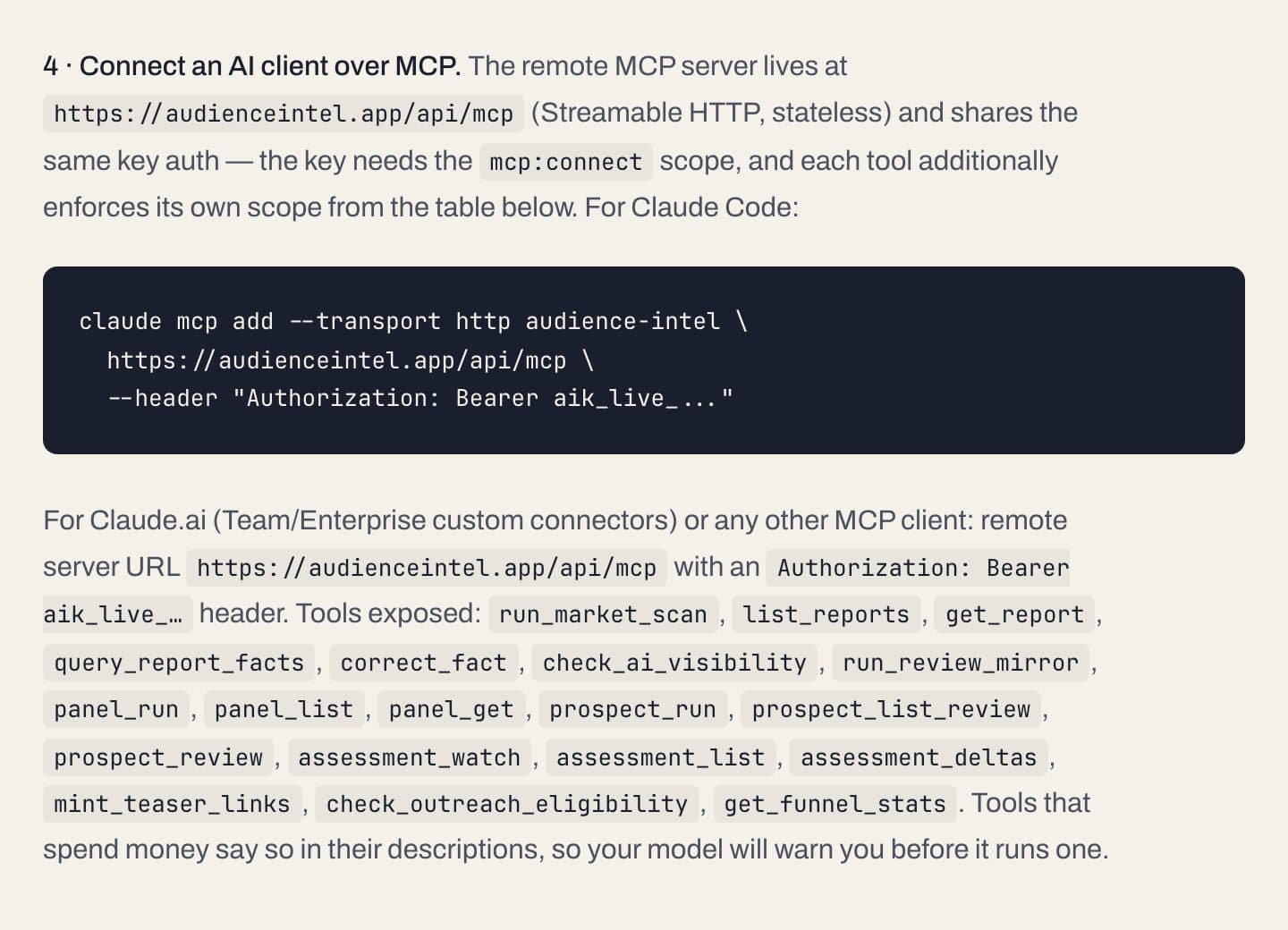
The MCP server exposes the same engine as tools an assistant client can call: running and reading scans, querying and correcting report facts, review reads, the synthetic panel, prospecting, assessment and outreach checks. It authenticates with the same keys.
Keys are issued by us after a conversation, not through a sign-up form. Each key carries explicit scopes (read reports, write scans and so on) and a daily spend cap in pence. A request that would exceed the cap is refused with a clear error. A key with a cap of zero cannot use anything that spends. An API that can run paid work needs a ceiling agreed in advance.
An OpenAPI 3.1 document, one error envelope and additive-only changes within v1.
The engine's main jobs as tools an MCP client can call, with the same keys.
Every key scoped to what it needs, with a daily spend ceiling.
Scans, facts and studies from your own tooling.
The engine available to assistant clients.
A daily ceiling per key, agreed up front.
A published spec and additive-only changes.
Tell us what you want to build and which parts of the engine you need.
We issue a key with the scopes and daily cap you need.
Call the API or connect an MCP client, using the published spec.
Keys and pricing are agreed in conversation; the Enterprise tier on the pricing page covers this.
Yes, after a conversation. Keys are issued by us, not through a sign-up form.
The OpenAPI 3.1 document is published, and the developer page links to it.
A daily spend cap on every key. A request that would exceed it is refused, and a key with a cap of zero cannot use anything that spends.
Only additively: new fields, endpoints and values, never renames, removals or new required inputs.
Live, sales-led. Keys are issued by us after a conversation; there is no self-serve sign-up.